
How to Set a Coffee Grinder: Practical Setup and Dial-In Guide for 2026
Learn how to set a coffee grinder for balanced extraction and cleaner cups in November 2026. Dial in burrs and blade runtimes for better daily coffee.
 By Jason Sarley
Updated November 13, 2026

Grind size serves as the master variable for brewing balanced, flavorful coffee across every extraction method. Mastering how to set a coffee grinder allows brewers to control water flow resistance, eliminate channeling, and curb excessive bitterness or sourness. Mechanical adjustment collars, stepped dials, and internal burr rings dictate the exact gap between cutting surfaces, directly shaping the ratio of boulders to micro-fines in your grounds. Paired with reliable equipment like manual burr grinders for filter brewing, dialing in the right particle size turns inconsistent morning cups into repeatable, café-quality extractions.
Electric machines with numbered settings and simple pulse-operated blade models require different approaches during initial setup. A burr grinder uses fixed mechanical spacing to deliver uniform particle distribution, whereas blade grinders rely entirely on motor run times and manual shaking techniques. Understanding the mechanical differences behind these tools helps prevent common frustrations such as stalled pour-over beds, sour espresso spritzing, and static mess across kitchen counters. Establishing a systematic baseline calibration routine ensures every roast profile yields its full aromatic potential without unnecessary bean waste.
| Award | Product | GCG Score About GCG ScoreThe GCG Score is our own rating from 0 to 10, based on performance, design and build, ease of use, and value. It reflects independent research and is never influenced by manufacturers, retailers, or affiliate commissions. Learn more › | |
|---|---|---|---|
| Best Overall |
MIGAKU HOME 5-Piece Coffee Cleaning Kit
|
9.1/10 | Buy |
| Best Premium |
 Lonkion Electric Burr Coffee Grinder |
8.9/10 | Buy |
| Best Budget |
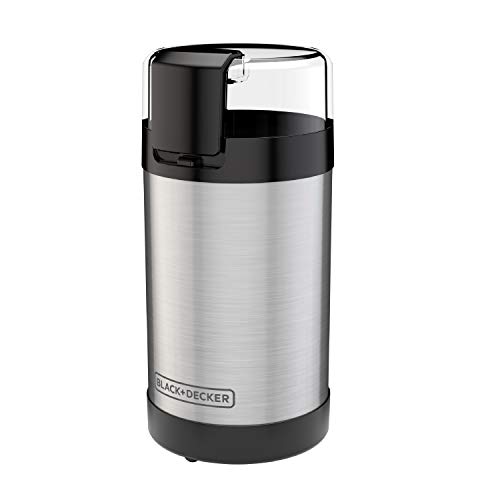 BLACK+DECKER One Touch Electric Coffee Grinder |
8.1/10 | Buy |
 Hamilton Beach Fresh Grind 12-Cup Grinder |
8.1/10 | Buy |
MIGAKU HOME 5-Piece Coffee Cleaning Kit
Equipped with natural black walnut brushes and a squeeze blower, this maintenance set clears loose grounds and stubborn residue from espresso group heads and grinders. It is an appealing, dedicated toolkit for home baristas focused on daily dry cleaning.
Pros
- Versatile tools handle both loose and stubborn grounds
- Attractive natural black walnut wood styling
- Includes dedicated brush for espresso group heads
- Requires no batteries or power source
Cons
- Manual air blower produces limited pressure
- Wood components require careful dry maintenance
- Physical brushes cannot descale internal water lines
Lonkion Electric Burr Coffee Grinder
The Lonkion Electric Burr Coffee Grinder features a flat metal burr mechanism with 28 adjustable settings and 2-to-12-cup auto-stop dosing for fresh whole bean brewing. It offers a compact, low-noise solution for everyday drip, pour-over, and French press drinkers looking to upgrade from pre-ground coffee.
Pros
- 28 distinct grind settings provide versatility for fine espresso through coarse French press brewing
- Flat metal burr design ensures more consistent grounds than standard blade grinders
- Automatic cup selector (2 to 12 cups) grinds the desired batch size with auto-shutoff
- Anti-static treated grounds bin and included cleaning brush help keep counters tidy
- Compact dimensions (3.65 x 6.2 x 7.3 inches) easily fit tight kitchen or office spaces
Cons
- Fine settings may require careful dialing in for non-pressurized espresso machine baskets
- Dark, oily whole beans can require regular burr chamber cleaning to avoid chute buildup
- Plastic container may still hold light static chaff under very dry household conditions
BLACK+DECKER One Touch Electric Coffee Grinder
The BLACK+DECKER One Touch Coffee Grinder provides a straightforward, 150-watt solution for grinding up to 2/3 cup of whole coffee beans, making it ideal for automatic drip and French press brewers. It is well suited for budget-conscious home drinkers seeking an easy, space-saving way to grind fresh whole beans every morning without complicated settings.
Pros
- Stainless steel blades and grinding bowl provide durable, long-lasting performance for whole coffee beans and spices
- One-touch push-button control makes it simple to pulse and customize grind consistency from coarse to fine
- Holds up to 2/3 cup of whole coffee beans, enough to brew a full pot in an automatic drip machine
- Integrated lid-locking safety feature prevents blade activation until the cover is firmly secured
- Compact 3.5 x 3.4 x 7.28 inch footprint occupies minimal counter space in home kitchens
Cons
- Blade grinding naturally produces less particle size uniformity than precision burr grinders, creating fines that may affect pour-over clarity
- Not designed to produce the consistent, ultra-fine grind required for non-pressurized espresso machines
- Dark, oily whole beans can leave residue around the blade bowl that requires frequent wiping between uses
Hamilton Beach Fresh Grind 12-Cup Grinder
Compact and user-friendly, the Hamilton Beach Fresh Grind processes beans for up to 12 cups of coffee alongside dried herbs and seeds. Its removable dishwasher-safe bowl and hideaway cord storage make it a practical, low-maintenance option for everyday countertops.
Pros
- Dishwasher-safe bowl simplifies cleanup
- Integrated cord storage keeps countertops organized
- Capable of grinding coffee, spices, and seeds
- Simple press-to-grind button control
Cons
- Blade design lacks adjustable grind size settings
- Manual pulse control requires visual monitoring
Dialing In Particle Size: The Comprehensive Guide to Setting Your Coffee Grinder
Setting a coffee grinder properly requires understanding how mechanical cutting geometry and run times govern particle size distribution. Whether adjusting a stepped burr collar or timing pulses on an entry-level blade machine, the goal remains identical: creating a uniform bed of grounds that matches your brewing method. When ground particles match brew water contact time, extraction achieves optimal sweetness, clarity, and aromatic balance. Rushing the calibration phase often leads to bitter, over-extracted astringency or sour, under-extracted cups that ruin high-quality whole beans.
The Mechanics of Grind Adjustment: Burrs Versus High-Speed Blades
Burr grinders and blade grinders manipulate coffee beans through fundamentally distinct mechanical actions. A flat burr mechanism, such as the assembly found inside the Lonkion Burr Coffee Grinder Electric, utilizes paired cutting discs that crush and slice beans to a uniform target dimension. Adjusting the dial on a burr machine physically widens or narrows the micrometric gap between these parallel surfaces. This precise separation restricts larger fragments from escaping the grinding chamber until they fracture into the calibrated particle size.
Blade grinders handle whole beans through rapid impact rather than controlled mechanical spacing. Units like the Hamilton Beach Fresh Grind Electric Coffee Grinder and the BLACK+DECKER One Touch Coffee Grinder rely on spinning stainless steel blades powered by high-speed motors. Instead of selecting a fixed click or collar setting, the user regulates particle fineness strictly by controlling pulse durations. Running the motor longer fractures beans into progressively smaller pieces, but it also generates a wider variance of microscopic fines and coarse boulders.
Recognizing these mechanical differences establishes realistic expectations for your brewing workflow. Burr systems provide repeatable numerical settings that make switching between drip, pour-over, and immersion brewing straightforward. Blade units require active user participation, rhythmic pulsing, and manual canister agitation to achieve acceptable consistency. Both equipment categories have a place on the home coffee bar, provided you apply the correct calibration technique to each mechanism.
Step-by-Step Initial Calibration: Finding Your Baseline Zero Point
Establishing an accurate baseline on a burr grinder begins with identifying the mechanical zero point. The mechanical zero represents the closest setting where the rotating and stationary cutting surfaces nearly touch without causing friction. Always ensure the machine is disconnected from electrical power before inspecting the burr chamber or adjusting collars toward their absolute tightest limit. Forcing burrs past the point of initial contact can dull sharp cutting facets or permanently damage motor drive bearings.
Once you locate the manufacturer zero reference or the tightest safe calibration stop, rotate the adjustment ring outward to your target brew range. Stepped grinders like the Lonkion electric model offer 28 distinct settings, which divide the total cutting distance into predictable intervals. Lower numbered settings position the burrs tightly together for concentrated extractions, while higher numbers widen the gap for gravity-fed percolation or immersion. Documenting your starting numerical setting on a notepad removes guesswork and accelerates dialing in fresh bags of whole beans.
Whenever you make fine adjustments toward a finer setting, always turn on the motor while turning the adjustment ring if beans remain inside the hopper. Adjusting a stationary grinder finer while roasted coffee sits between the burrs can wedge hard bean fragments against the cutting teeth. This sudden resistance can bind the drive shaft or trigger the internal overheat protection system designed to protect electric motors. Running the motor during adjustment ensures any trapped grounds clear smoothly through the discharge chute.
Dialing In for Specific Brewing Methods: From Espresso to Immersion
Every coffee brewing device operates within a specific contact window that dictates your required particle surface area. Espresso demands a fine, powdery grind capable of generating enough hydraulic resistance against nine bars of water pressure. If water rushes through your espresso portafilter in under twenty seconds, the grind setting is excessively coarse and allows channeling. Conversely, an overly fine setting chokes the espresso machine, stalling extraction and producing a harsh, astringent cup.
Pour-over cones and automatic drip carafes require a medium-fine to medium particle size resembling granulated table salt. Water must percolate steadily through the coffee bed without stalling against compacted fines or channeling through loose fissures. For households brewing large morning pots, matching the right grind setting with drip brewers with built-in grinders ensures that water dispersion rates stay synchronized with particle saturation. A well-calibrated medium setting delivers a flat brew bed with clear flavor separation and vibrant sweetness.
Immersion brewing methods such as the French press and cold brew perform best with medium-coarse to coarse grinds resembling sea salt. Extended water contact times compensate for the larger particle dimensions, allowing gentle flavor diffusion without over-extracting bitter chlorogenic acids. Coarse particles also remain trapped behind metal mesh filters, yielding a clean beverage with minimal muddy sediment in your mug. If your French press plunge requires excessive force, your grind setting is too fine and generates too many suspended micro-fines.
Operating Blade Grinders: Pulse Timing and Agitation Techniques
Calibrating a blade grinder requires replacing mechanical settings with precise timing and physical technique. Holding down the power button continuously on units like the Hamilton Beach Fresh Grind or the BLACK+DECKER One Touch can generate excessive frictional heat. Thermal transfer from high-speed spinning blades quickly degrades delicate aromatic compounds in roasted coffee beans before water ever touches them. Short, controlled pulses lasting two to three seconds each prevent heat buildup while offering better control over particle reduction.
Agitation during the grinding cycle significantly improves the particle uniformity produced by high-speed spinning blades. Gently shaking the grinder vertically or tilting it in a circular motion between pulses encourages uncracked beans to fall toward the cutting path. Without deliberate agitation, beans resting directly against the bowl base pulverize into powder while top-layer beans remain in large chunks. Utilizing the integrated lid-locking safety feature ensures the grinding bowl remains firmly sealed during these vigorous shaking routines.
Establishing consistent pulse counts acts as your makeshift adjustment dial when working with blade appliances. Counting eight to ten pulses typically produces a coarse consistency suitable for cold immersion or French press brewing. Extending that duration to fifteen or twenty pulses reduces particles toward a medium texture compatible with drip coffee makers. While blade units cannot achieve the pinpoint uniformity of precision burrs, mastering rhythm and agitation unlocks solid results for daily budget-conscious brewing.
Managing Static Cling and Retention in Daily Workflows
Static electricity frequently disrupts home grinding workflows by causing grounds and silvery chaff to adhere stubbornly to plastic surfaces. Friction generated during bean fracturing creates triboelectric charges that cause flyaway coffee dust to scatter across countertops. Manufacturers often address this nuisance with specialized container materials, such as the static-treated plastic grounds bin supplied with the Lonkion burr grinder. These treated surfaces discourage particles from clinging to container walls, allowing grounds to pour cleanly into your brew basket.
Applying the Ross Droplet Technique provides an effective method for mitigating static in setups without anti-static coatings. Dipping a small spoon handle or needle into clean water and stirring whole beans before grinding introduces microscopic humidity. This minute amount of moisture dissipates surface charges without wetting internal burr components or causing mechanical corrosion. Never add excessive water, as moisture can cause stale grounds to paste against burr teeth and promote rust on carbon steel mechanisms.
Internal coffee retention presents another hidden variable that frequently distorts grind setting adjustments. Small quantities of coffee grounds naturally linger in internal chutes, sweeps, and burr chambers between uses. When you switch settings from coarse to fine, the first few grams of grounds exiting the chute consist of old coffee ground at the previous setting. Purging a small test dose of beans whenever you modify your grind dial ensures your brew receives exclusively fresh, correctly sized particles.
Routine Cleaning and Burr Maintenance to Maintain Calibration
Accumulated coffee oils and compacted fines gradually alter the physical spacing between burrs over weeks of regular grinding. Oily residue creates a gummy coating inside adjustment threads and along cutting flutes, throwing off numerical calibration dials. Utilizing a comprehensive maintenance kit like the MIGAKU HOME Coffee Grinder Cleaning Kit helps maintain equipment precision without risking component damage. Soft walnut brushes gently sweep loose dust from delicate chutes, while firm-bristle brushes dislodge stubborn caked residue from hardened metal cutting teeth.
Routine cleaning routines should prioritize dry mechanical removal rather than chemical washes or liquid rinsing. Disconnect the grinder from power and use long-reach brushes to clear hidden crevices around the exit chute and lower motor sweep. Squeezing a specialized rubber air blower dislodges packed chaff from tight gaps without introducing moisture to electronic housing boards. Keeping the grinding chamber dry preserves the integrity of internal drive shafts and prevents rancid coffee oils from spoiling fresh roasts.
Removable dishwasher-safe parts provide convenient sanitation options for blade grinder owners seeking straightforward cleanup. The stainless steel grinding bowl on the Hamilton Beach electric model detaches cleanly from the motorized motor base for washing. Never submerge motorized bases, power cords, or integrated electrical components in water under any circumstances. Allowing completely dried parts to reassemble before your next morning session prevents electrical hazards and keeps your grinding routine running smoothly.
Diagnosing Extraction Flaws and Making Fine Corrections
Tasting your brewed coffee critically provides the most accurate feedback for fine-tuning grinder settings. Under-extraction occurs when water flows too rapidly through a coarse coffee bed, leaving organic acids unneutralized. The resulting cup tastes predominantly sour, sharp, and hollow, lacking lingering body or natural sweetness. Moving your burr collar one or two clicks toward a finer setting increases surface area, slowing percolation and restoring flavor balance.
Over-extraction manifests when brew water remains trapped in prolonged contact with overly fine coffee particles. The cup delivers harsh bitterness, a dry astringent sensation on the tongue, and muddy or muddled tasting notes. Inspecting the top of your brew bed often reveals a muddy layer of fines that stalled the water drawdown entirely. Clicking your adjustment mechanism outward toward a coarser setting accelerates drainage, allowing clean aromatics and crisp acidity to shine.
Make minor, single-step modifications rather than dramatic leaps across your adjustment dial when troubleshooting extraction balance. Shifting multiple settings simultaneously introduces confusing variables that make isolating the ideal grind setting difficult. Keep your coffee dose weight, water temperature, and pouring technique constant while modifying only the grind dimension. This disciplined, single-variable approach rapidly converges on the sweet spot for any roasted origin or processing style.
Capacity, Workflow, and Practical Setup Considerations
Selecting the right grinder settings also intersects directly with daily brewing volume and countertop convenience. Single-dose routines benefit from minimal hopper storage, while batch brewing requires hopper capacities capable of feeding ten to twelve cups simultaneously. Exploring large capacity coffee grinders provides helpful perspective for households that routinely prepare full carafes for family gatherings or busy workdays. Matching bean capacity with motor duty cycles prevents thermal overload cutoffs during consecutive batch operations.
Countertop footprints, cord management, and acoustic pitch shape the long-term usability of your coffee grinding station. Compact units featuring hidden cord storage keep kitchen workspaces tidy, while low-noise motors prevent morning disturbances in sleeping households. Models equipped with automatic cup selectors simplify multi-cup dosing by measuring run time according to chosen volume settings. Balancing convenient automated features against manual dialing control lets you build an efficient routine tailored to your kitchen space.
Ultimately, learning how to set and adjust your coffee grinder transforms whole beans into vibrant, repeatable beverages every morning. Taking time to establish your mechanical zero, maintaining clean burrs, and listening to sensory cues in the cup ensures consistently balanced coffee. Regardless of whether you operate a precision multi-step burr machine or a quick-pulsing blade model, deliberate adjustment techniques maximize your coffee enjoyment.
About the author
Jason Sarley is a coffee professional, writer, roaster, and licensed Q Grader with extensive experience in cupping and coffee evaluation. He also holds professional roasting credentials and has worked closely with innovative brewing technology, giving him practical insight into how brewing equipment, extraction methods, and coffee quality come together in the cup.