
How to Use Capresso Coffee Grinder: Practical Guide for 2026
Learn how to use capresso coffee grinder with dial settings, blade versus burr techniques, and static solutions updated for November 2026.
 By Ashley Rodriguez
Updated November 12, 2026

Balanced coffee extraction relies on uniform particle distribution and gentle handling of delicate roasted beans. Mastering %how to use capresso coffee grinder% machines allows coffee lovers to unlock nuanced flavor profiles across multiple brewing styles while preventing bitter over-extraction. Capresso manufactures versatile equipment for domestic brewing, from compact blade grinders to commercial-grade conical burr machines. Home brewers exploring a dedicated electric setup often weigh standalone units against an integrated drip brewer with grinder to streamline their morning workflow.
Operating these grinders efficiently demands an understanding of grind settings, motor thermal dynamics, and routine maintenance protocols. The solid steel conical burrs and gear-reduction motor found in advanced Capresso models preserve delicate aromatics by keeping grinding friction low. Meanwhile, entry-level blade choppers require specific pulsing methods to avoid scorching volatile compounds. Following structured operating procedures ensures consistent particle uniformity, reduces countertop static mess, and extends the lifespan of your appliance.
| Award | Product | GCG Score About GCG ScoreThe GCG Score is our own rating from 0 to 10, based on performance, design and build, ease of use, and value. It reflects independent research and is never influenced by manufacturers, retailers, or affiliate commissions. Learn more › | |
|---|---|---|---|
| Best Overall |
Capresso Infinity Plus Conical Burr Grinder
|
8.9/10 | Buy |
| Best Budget |
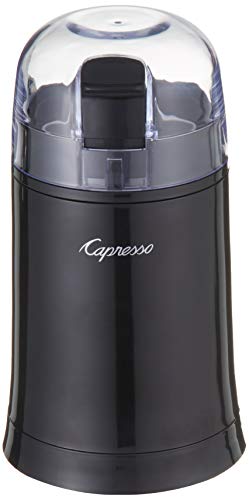 Capresso Cool Grind Coffee & Spice Grinder |
8.4/10 | Buy |
 Generic Grounds Container for Capresso Infinity |
7.8/10 | Buy |
Capresso Infinity Plus Conical Burr Grinder
The Capresso Infinity Plus is a compact electric conical burr grinder built with solid steel burrs and a gear-reduction motor to minimize grinding heat. It is an accessible choice for drip, pour-over, and French press brewers seeking a reliable upgrade from blade grinders.
Pros
- Solid steel conical burrs provide a noticeable particle consistency upgrade over high-speed blade choppers
- Gear reduction motor helps mitigate friction and heat buildup during extended grinding sessions
- Wide 16-step adjustment range covers everything from Turkish fine to coarse cold brew brewing
- Large 11-ounce bean hopper minimizes frequent refilling for everyday batch drip coffee drinkers
- Compact footprint of 5 x 7.75 x 11.25 inches fits conveniently beneath standard kitchen wall cabinets
Cons
- Stepped 16-setting dial lacks the micro-step resolution required for precise dialing on non-pressurized espresso machines
- Clear plastic grounds container and hopper can collect static cling and chaff without routine wiping or moisture prep
- Not configured for direct portafilter dosing, requiring grounds transfer from the 4-ounce catch bin
Capresso Cool Grind Coffee & Spice Grinder
Equipped with a fast-stopping stainless steel blade, this compact unit quickly grinds up to 3.5 ounces of whole beans or dried spices. It serves coffee drinkers and home cooks looking for a versatile, low-heat grinder that stores neatly on small countertops.
Pros
- Large 3.5-ounce capacity yields over 15 brewed cups
- Low heat buildup protects delicate bean aroma
- One-second blade stop ensures safe daily operation
- Handles both whole coffee beans and dried spices
- Integrated cord storage beneath base saves counter space
Cons
- ABS plastic exterior rather than metal build
- Blade grinder mechanism rather than adjustable burrs
Generic Grounds Container for Capresso Infinity
Designed as a direct replacement bin for the Capresso Infinity grinder, this container neatly catches grounds to keep countertops clean. It offers a practical and quick swap for lost or damaged original parts.
Pros
- Direct replacement for Capresso Infinity grinders
- Effectively contains stray coffee grounds
- Quick and tool-free drop-in installation
- Restores grinder functionality easily
Cons
- Third-party accessory rather than an OEM part
- Compatible only with Capresso Infinity grinders
Mastering Operation and Dial-In for Capresso Coffee Grinders
Understanding %how to use capresso coffee grinder% equipment correctly ensures that your coffee bed extracts evenly across any chosen brewing method. Dialing in your machine involves balancing burr collar adjustments with whole bean dosing and motor run times. Proper machine handling also shields delicate bean aromatics from friction-induced heat while avoiding common issues like motor stalling or excessive static spray. Following a systematic operational sequence delivers cleaner cups and protects mechanical components from premature wear.
Component Anatomy and Initial Machine Setup
Initial setup begins with placing the grinder on a clean, dry, and level countertop near a standard electrical outlet. Conical burr units like the Capresso Infinity Plus Conical Burr Grinder, Black feature an eleven-ounce transparent bean container, a removable upper conical burr, and a four-ounce ground coffee receptacle. Inspect the burr housing before plugging in the power cord to verify that no foreign debris or loose packaging fragments remain in the burr throat. Ensuring the workspace is dry protects the electrical motor base from moisture hazards.
Proper hopper alignment is essential because Capresso incorporates an internal safety micro-switch mechanism. The clear bean hopper must be seated straight into the grinder collar and rotated clockwise until the indicator arrow moves into the active grind adjustment range. The motor will not receive electrical power if the hopper is misaligned or turned too far toward the unlock position. Sliding the ground coffee bin squarely into the front recess completes the initial mechanical assembly, preventing ground particles from scattering across the counter during operation.
Fill the hopper only with roasted whole coffee beans suited for brewing. Avoid introducing unroasted green beans, sticky flavored beans coated with sugar syrups, or non-coffee food items into the burr chamber. Standard roasted beans fracture cleanly under the commercial-grade solid steel cutting flutes without leaving gummy residues. Verifying that each component is locked into place establishes a reliable foundation for daily brewing and prevents accidental motor binding.
Navigating the Sixteen Collar Settings for Different Brew Methods
The Capresso Infinity Plus provides sixteen distinct fineness settings arranged across four macro categories. These marked brewing zones include extra fine, fine, medium, and coarse. Extra fine settings are calibrated for Turkish coffee preparation, producing a powdery flour-like texture that suspends readily in hot water. Fine settings provide the particle resistance necessary for pump espresso machines and stovetop moka pots, delivering adequate puck resistance to slow pressurized water flow.
Medium settings serve standard automatic drip machines, Chemex carafes, and single-cup pour-over cones. Aligning the collar within this central zone ensures water percolates through the coffee bed at a steady pace without stalling filter papers or channeling through dense spots. Home brewers who examine extraction clarity across different tools often compare particle uniformity with manual burr grinders for French press and pour-over to calibrate their target brew drawdown times. Achieving the right medium grind balance prevents the bitter astringency caused by excessive micro-fines.
Coarse settings are intended for French press immersion, percolators, and prolonged steeping methods like cold brew. Turning the selector collar toward the coarsest notches produces distinct particulate pieces while minimizing the production of fine sediment that muddies immersion brews. Comparing coarse particle separation against specialized manual cold brew grinder options helps illustrate how consistent coarse grounds preserve sweet, clean flavor notes during long extractions. A reliable coarse distribution keeps the wire mesh filter of a French press plunger from clogging.
Always adjust the grind selector ring while the motor is running or when the hopper is completely empty. Turning the collar to a finer notch while beans remain trapped between stationary burrs forces the cutting flutes against rigid bean fragments. This resistance places strain on the adjustment collar threads and can misalign the upper burr carrier. Running the motor briefly during adjustment allows trapped coffee particles to clear through the chute freely, ensuring smooth collar rotation.
Operating the Timed Grinding Dial and Dosing Accurately
Capresso burr grinders utilize a mechanical rotary timer dial on the front housing to activate the motor. Rotating the timer dial clockwise winds an internal spring mechanism, running the burrs until the switch returns to the off mark. The numerals printed around the timer dial indicate run duration rather than exact gram portions. Because roast degree, bean size, and collar setting influence bean throughput speed, relying solely on timer marks produces natural dose variance.
Home baristas seeking consistent cup strength should weigh whole bean doses on an accurate digital kitchen scale before grinding. Weigh your required dose, such as thirty grams for a two-cup manual pour-over, and pour that measured portion directly into the hopper. Turn the mechanical timer dial past the estimated run duration, allowing the steel burrs to process the entire dose. Once the pitch of the motor changes to indicate an empty grinding chamber, manually turn the dial counter-clockwise back to the off position to stop the machine.
The gear-reduction motor integrated into Capresso conical burr units plays a crucial role during extended dosing. By reducing rotational speed, the gear train minimizes frictional heat generation inside the cutting zone. High-speed motors can warm delicate whole beans, prematurely vaporizing volatile aromatic compounds before hot brewing water touches the grounds. The slower burr rotation also creates a deeper, lower-frequency sound profile that makes early-morning grinding quieter in shared living spaces.
Pulsing Techniques for Capresso Blade Grinders
Operating a blade appliance like the Capresso Cool Grind Coffee/Spice Grinder, Black requires a distinct manual technique compared to conical burr machines. Blade grinders rely on dual stainless steel blades spinning at high velocity to chop whole beans into fragments through repeated impact. Holding down the continuous power switch creates significant localized friction, scorching the beans while generating an uneven mix of coarse boulders and fine dust.
To produce an acceptable particle consistency, activate the motor in short pulses lasting two to three seconds each. Between individual pulses, gently shake or tilt the grinder horizontally to redistribute large bean fragments down into the blade cutting path. This intermittent pulsing technique minimizes frictional heat buildup inside the stainless steel grinding chamber, preserving aromatic oils while encouraging a more balanced grind distribution. Repeating this pulsing and shaking cycle four to six times produces an even medium grind suited for standard drip makers.
Operational safety is incorporated directly into the transparent lid activation mechanism of the Cool Grind. The high-speed motor engages only when the top lid is seated firmly over the stainless steel chamber and pressed down by hand. Releasing pressure from the lid causes the fast-stopping blade mechanism to halt rotation within one second, ensuring safe handling between pulses. The three-and-a-half-ounce chamber accommodates enough coffee for up to fifteen cups or transitions easily into grinding dried spices.
Mitigating Static Cling and Managing Grounds Containers
Triboelectric static charge represents a widespread operational frustration when grinding dry whole beans. Friction generated as coffee beans shear into small fragments transfers electrostatic charges to the plastic grounds bin and internal exit chute. This charge causes lightweight chaff flakes and fine coffee dust to cling stubbornly to the container walls or scatter across kitchen surfaces when you slide the bin out. Dry ambient winter conditions often amplify this flyaway powder issue.
Applying the Ross Droplet Technique provides an effective method to neutralize static charges before grinding begins. Dip the tip of a spoon handle into clean water and stir it briefly through your measured portion of whole beans before pouring them into the hopper. This microscopic trace of surface humidity increases surface conductivity, allowing electrostatic charges to dissipate harmlessly through the grinding chamber. Using only a single droplet avoids moisture accumulation on the steel cutting teeth and prevents wet grounds from caking inside the chute.
When factory grounds bins suffer from wear or accidental damage, using a compatible aftermarket container restores clean daily operation. The Coffee Powder Collector Compatible with Capresso is designed as a third-party replacement grounds receptacle that slides directly into the collection cavity of Infinity models. Allowing the grinder to rest for ten to fifteen seconds after grinding stops gives airborne grounds time to settle inside the collector, substantially reducing countertop mess when you remove the bin.
Disassembly, Deep Cleaning, and Burr Chamber Maintenance
Routine cleaning is essential to preserve pure coffee taste and protect internal mechanical components from excessive rotational drag. Natural coffee oils deposit onto steel cutting flutes over time, oxidizing into rancid residues that taint fresh brews with stale, bitter off-notes. Compacted coffee dust also settles into chute crevices and collar threads, making fine adjustments stiff and difficult to turn. Performing a quick cleaning cycle every two to three weeks maintains peak cutting efficiency.
Always disconnect the electrical power plug from the wall socket before dismantling any part of the grinding assembly. Empty any remaining beans from the hopper, then rotate the bean container counter-clockwise past the coarsest setting until the alignment marks match the removal tab. Lift the hopper straight off the motorized chassis to expose the upper burr assembly. Grasp the folding metal handle on the upper conical burr ring, twist it slightly to disengage the retention notches, and lift the burr out of the collar.
Brush away loose coffee grounds from both the removable upper burr and the fixed lower burr flutes using a stiff-bristle cleaning brush. Use a soft wooden toothpick or the narrow handle of your cleaning brush to dislodge compacted fines from the downward chute leading into the collection cavity. Never submerge the steel burrs, motorized housing, or internal gear assembly in water or clean them in an automatic dishwasher. Moisture causes steel cutting surfaces to oxidize rapidly, dulling sharp edges and degrading grind consistency.
Reassembling the grinder requires careful alignment to avoid cross-threading the adjustment collar. Lower the upper conical burr back into the chassis, confirming that the molded alignment tabs seat completely into their matching perimeter cutouts. Replace the transparent bean hopper by aligning its indicator arrow with the chassis marking, push down gently, and turn the hopper clockwise into the active grinding zone. If the hopper resists turning, remove it immediately to ensure the upper burr sits flush in its carrier before rotating the collar again.
Troubleshooting Jammed Burrs and Motor Interruptions
If the grinder motor hums softly without rotating the burrs, switch the timer knob to the off position immediately and disconnect the power plug. Motor jamming occurs most frequently when a small pebble, unroasted bean, or unusually dense bean fragment lodges tightly between the inner and outer burr flutes. Leaving power connected while the motor armature is trapped can trigger internal thermal cutoff switches or strip drive gear teeth. Prompt action protects the motor windings from electrical overload.
Unplug the machine, remove the bean hopper, and inspect the grinding throat under good lighting to locate the obstruction. Remove loose whole beans and use a pair of narrow tweezers to extract any hard object caught between the steel cutting teeth. Vacuum out remaining loose grounds, reseat the upper conical burr securely, and set the adjustment collar to a coarse position before reconnecting power. Starting the motor on a coarse setting provides maximum physical clearance for any residual particles to clear without resistance.
Dark, oily roasts ground on extra fine settings can also form a dense paste that packs tightly beneath the lower sweep arms. If the burrs spin freely but grounds fail to exit into the collection bin, clear the compacted chute passage with a dry brush. Respecting manufacturer duty-cycle recommendations by allowing the motor to rest for several minutes between back-to-back grinding sessions prevents heat accumulation and ensures reliable mechanical performance over years of daily brewing.
Practical Workflow Habits for Consistent Extraction
Developing disciplined daily grinding habits maximizes the cup clarity your Capresso equipment can produce. Store whole coffee beans in an opaque, airtight canister rather than treating the clear grinder hopper as long-term bean storage. Dispensing only the exact dose you intend to brew keeps your coffee fresh and reduces chute retention exchange from stale grounds resting in the chamber between mornings.
Combining accurate dose weighing, correct collar selection, and periodic dry brushing ensures your coffee bed extracts evenly with every brew. Understanding the mechanical differences between high-speed blade pulsing and low-friction conical burr shearing empowers you to adapt your workflow to any coffee roast. With proper operation and attentive care, your grinder will consistently deliver the precise grind distribution needed for rich, balanced coffee.
About the author
Ashley Rodriguez is an experienced barista, coffee writer, and editor with more than a decade of hands-on experience in specialty coffee. Her work combines practical brewing knowledge with thoughtful consumer education, helping readers better understand coffee preparation, café practices, equipment, and the people and processes behind a great cup.